Selling the Air Force
BY KEVIN M. HERSTINE

In January 2020, the U.S. Air Force—smarting from an audit agency report highlighting ineffective management and poor fiscal responsibility in its advertising and recruiting programs—kicked off a market intelligence study of its marketing and recruiting services. The Senate Armed Services Committee report on the Fiscal 2021 National Defense Authorization Act identified approximately $227 million in annual Air Force spending in the category and proposed to cut it by $40 million to spur the service to revamp its program. [i]
This is the story of how the Air Force learned the intricacies of the commercial advertising and recruiting market, compared itself with government and private sector best practices, and produced a category intelligence report (CIR) with 11 key recommendations now being executed in a marketing and recruiting (M&R) overhaul.
The audit coupled with ongoing Senate Armed Services Committee attention made the M&R CIR a high-visibility effort, such that Honorable Shon Manasco, then the acting under secretary of the Air Force, sponsored it. The CIR team sought to produce a total force report covering Active Duty, Air Force Reserve, Air National Guard, and Civilian Service marketing and recruiting requirements.
As we began the CIR, we realized that our research was going to fall into three main areas: recruiting, marketing for recruiting, and commercial marketing.
Under the recruiting portion, we focused on best practices for leads and accessions. Leads are essentially prospects who meet certain age, citizenship, character, and fitness requirements. Accessions are the contracts between new recruits and the Air Force. Here, we identified processes and tools used by recruiters to manage those leads and accessions.
Under the marketing for recruiting portion of the scope, we identified best practices of organizations that advertise their brands and value propositions as employers. They are marketing their companies and the benefits of working for them, not necessarily the specific products and services they provide to customers.
Under commercial marketing, we identified applicable best practices of major consumer goods corporations. This is standard Marketing 101: the food, beverage, technology, hospitality, automotive and other ads we all receive in a variety of ways.
A Tiny Pool of Potential Recruits
One of the primary drivers for conducting CIRs is solving mission and functional problems. So, we identified the specific Air Force’s challenges facing its marketing and recruiting mission. For example, of the 20 million people in the United States youth pool, only about 2.3 percent have high academic quality, are eligible, and have a propensity to serve in the military. That same 2.3 percent is being actively pursued by the other military services, government agencies, and private industry. This makes the effectiveness and efficiency of our marketing and recruiting efforts that much more important—and difficult.
Another key challenge was that the Air Force was (and is) in the process of converting to a total force recruiting model, which triggered a massive shift in each component's existing process. We that realized the Active-Duty side marketed differently from the Reserve and Civilian Services, and due to the states’ involvement, the Guard did things differently than everyone else. Integrating these components was a significant undertaking. This drove us to seek out organizations like the Army and Navy, which had already integrated their marketing to identify relevant lessons learned and best practices.
Although the marketing industry is unique, it is still a commercial service. As a result, it suffers from many of the same problems as the other commodities and commercial services the Air Force buys. Marketing requirements are subject to delayed distribution of funds, taxing from higher organizations, and funding that is not obligated until late in the fiscal year. About 65 percent of Air Force marketing spend occurs in the fourth quarter. Not only is that problematic from a planning perspective, but we found that the standard commercial purchasing windows were in December and April. Historically, the majority of Air Force funds were being delayed until May or June and largely left unobligated until September; we were missing the commercial purchasing windows and hurting our buying power. The Air Force is not the only one interested in purchasing ad space on the most popular shows on network television. If we are not bringing our money to the table when the rest of the market does, we miss out on the premium deals.
Insufficient recruiting personnel and organic marketing expertise proved yet another challenge. The Air Force’s recruiting manpower pales in comparison to the sister services, both in terms of frontline recruiters and the centralized marketing divisions that work behind the scenes. In addition to being largely outmanned, Air Force marketing teams lacked practical marketing experience and education, resulting in an overreliance on contractors. It is difficult to assess contractor proposals, strategies, evaluate campaign and ad performance, and interpret data without some level of organic expertise.

Stove-Piped Marketing
Not surprisingly, the four Air Force components, which have always marketed independently, had inconsistent processes. That fact resulted in varied definitions, metrics, and return-on-investment (ROI) calculations, which complicates the transition to a total force model.
The Air Force’s “Inspire, Engage, and Recruit” approach to securing leads also presents ROI challenges. If you think of that approach is a funnel, inspire is the opening, the widest portion. It includes things like air shows, where there might be a 10-year-old child who sees a fighter pilot demonstration and wants to join the Air Force. That air show investment does not pay dividends for eight to 10 years until the child becomes and adult and decides to enlist. Money spent today for a lead that does not turn up for a decade can be a hard sell, but industry faces some of those long-term investments too. So, we knew we could find comparable methods in industry through our research.
Marketing stove-piping among our components led to redundant spend, cannibalization of leads, and some issues with brand awareness. Redundant spend occurred when, for example, all our components attended the same recruiting event with separate tents. Cannibalization took the form of each component buying its own distinct marketing and advertising, while going after that same 2.3 percent of the youth population.
The brand awareness challenges were primarily an issue with the Guard. Each state wants to put its own spin on being part of the Guard; however, from a brand recognition standpoint, the further you get from the Guard as a parent brand, the harder it is to communicate and connect with an audience. As a result, only 6 percent of the public is familiar with the component itself, negatively impacting its ability to recruit.
We configured these collective challenges into a set of research hypotheses, which became the framework for our analysis. We knew the prioritized topics we needed to explore and the specific data points we had to gather during our research to validate or invalidate our hypotheses. It is important to define your relevant market before conducting research and outreach. Though the Air Force mission is unique, by breaking it into individual aspects, we were able to find comparable private and public benchmarks. We leveraged open-source articles and information found during desk research. We pulled in several pertinent industry and market reports from the Air Force subscription to market intelligence provider IBISWorld and Procurement IQ. Then we conducted our targeted interviews.
The Power of Interviews
Of all our research tactics, targeted interviews were by far the most effective means for obtaining valuable industry data. We developed interview guides and customized questions sets for different organizations to ensure we prioritized the most relevant topics. The questions we developed for the Army might not be as significant or applicable to Marriott or NASA. We wanted to be mindful of everyone's time during interviews, so we front-loaded the key questions to ensure we gathered the most beneficial information first.
Interview targets for marketing and recruiting included the military services. We developed case studies for both the Army and Navy. As mentioned, both had previously integrated their marketing and recruiting missions, so there was a lot to learn from them. The case studies proved highly relevant and provided a lot of great data for our project since the Army and Navy are subject to the same regulatory standards and laws as the Air Force. We also investigated similar non-DOD agencies and foreign military services.
We conducted interviews with NASA, the Royal Netherlands Air Force, International security firms, and analogous companies and organizations, such as USAA Talent Acquisition, USAA Marketing, Southern New Hampshire University, PepsiCo, and Marriott. Lastly, we sought out subject matter experts on the particulars of some of the leading marketing tactics in the field today, including demand-centric growth, personalization, and the use of customer data platforms.
Best Practices
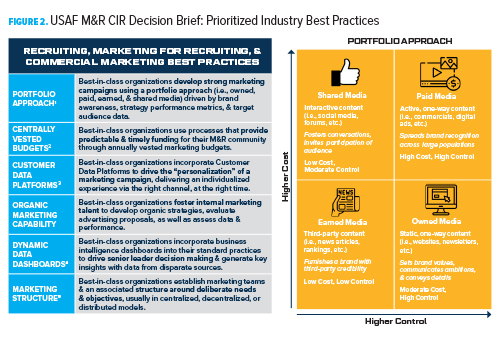
While this is not an exhaustive list of all the best practices we identified, we deemed these six as the most relevant and impactful:
- Marketing and Advertising Portfolio Approach,
- Centrally Vested Budgets,
- Customer Data Platforms and Personalization,
- Organic Marketing Capability,
- Dynamic Data Dashboards, and
- Deliberate Marketing Structures.
In a portfolio approach, each form of media carries a different level of cost and control. Paid media, such as a commercial, is often more costly, but you have a significant level of control in terms of the content being conveyed to your target audience since it is a one-way exchange. Shared media such as Facebook and Instagram posts have lower costs; on the other hand, you have less control in terms of how the audience interacts with your media—either in a positive or negative way. Each form of media serves a different purpose, so you want to align your investments to meet your marketing objectives and needs. Most Air Force components were already leveraging a portfolio approach for their marketing strategies.
As previously mentioned, the Air Force M&R community was facing significant challenges associated with their funding pipelines. Many of the analogous industries we interviewed do not face those same funding and budgetary hurdles; they are therefore able to expend their funds in accordance with key industry purchasing windows and obtain optimal placement and promotion. So predictable and timely funding are clear tenets of best-in-class organizations.
A customer data platform is the most effective way to track, store, integrate, and use data regarding target markets and potential leads. This type of leveraged data can feed into marketing personalization, which allows us to contact potential leads at the right time through their preferred platforms. This helps us to increase the likelihood of converting a lead into a recruit as well as to ensure we are applying resources against the most valuable marketing and recruiting tactics for our target demographic. For example, if you are trying to contact an 18-year-old, it is more effective to reach them via text messages or social media versus trying to call them by phone. An effective customer data platform will help you identify those preferences and assist with executing tailored strategies.
Maintaining organic marketing capability was another best practice we uncovered. Industry considers marketing a core competency and only outsources the advertising portion of their requirements. The Air Force has no marketing series for its civilian or military workforce and as such has been outsourcing its marketing and advertising requirements.
Data has become an indispensable asset and dynamic data dashboards enable decision-making at the tactical, strategic, and enterprise levels. We found that most Air Force components were receiving access to data dashboards from their prime contractors, but there were still opportunities to improve their use. Some cases were less about the data and more about how we were using the dashboards themselves. For instance, one component was receiving certain dashboards on a weekly basis, but required six months’ worth of trend analysis to support a decision. Like all contract deliverables, every time they received one of those products, they were paying for it. So, if the data is not useful in a weekly snapshot, then we should adjust the frequency of those deliverables to align with how we actually use them.
Finally, we learned that it is imperative to structure marketing teams to meet the Air Force’s objectives and needs as an integrated force. Organizations tend to have either centralized, distributed, or hybrid marketing approaches. We felt that a distributed model made most sense for the Air Force moving forward to address its national advertising campaigns as well as local and regional strategies to support the Reserve and Guard. Understanding those linkages and leveraging similar themes, materials, and media can result in a more effective program and a consistent brand image.
Targeting Talent
This project ultimately made 11 recommendations to the assistant secretary of the Air Force for manpower and reserve affairs, who has statutory authority over all the Air Force components.
- Expand Air Force Total Force Recruiting under a Distributed Marketing Model to achieve optimized national, regional, and local marketing objectives.
- Establish Centrally Vested Funding under the Integrated Marketing Division to obtain timely funds, secure elite advertising assets, and achieve preferred pricing by leveraging department-level demand.
- Pursue Multiple Year Appropriations for greater discretion and flexibility to adjust to internal and external market factors that impact this requirement set.
- Develop Standardized Requirements, Definitions, and Metrics at the enterprise level.
- Consolidate National Advertising Acquisitions to leverage department-level buying power, deliver a consistent brand image, and achieve process efficiencies.
- Foster Organic Marketing Capability to allow the Air Force to develop strategize and validate contractor performance and associated data.
- Implement a Data-Driven Portfolio Approach that Prioritizes Digital Media given target demographic preferences.
- Enhance Customer Data Platforms and Lead Refinement Processes to further substantiate ROI calculations and compete for talent.
- Optimize the Total Force Recruiting Social Media Strategy to encourage collaboration across the components and deliver a farther-reaching, more engaging social media presence.
- Use Predictive Modeling to Optimize Investments to identify the best opportunities for investment, from recruiting resources to advertising to retention efforts.
The Air Force is usually very good at examining itself and how it does business, and at recognizing its internal best practices. Where the Air Force has struggled historically is in understanding the industry perspective and how our requirements operate outside the fence line. Without those external perspectives and benchmarks, sometimes we are left operating in a vacuum. We think we are following commercial standards and have satisfactory pricing and performance, but in reality we can be way off the mark. This makes the case for market intelligence: It can validate that you are running your organization or business in the most efficient and effective manner possible. If there is room for improvement, market intelligence can help educate you on best practices, emerging trends, and new technology, and inform your strategies to enhance your management and requirements. Conducting effective market intelligence before making a decision can never hurt. In the worst-case scenario, you find out that you are doing everything right. Despite these challenges, the Air Force has made its recruiting goal for the last 22 years and has done so at the lowest cost-per-accession among the Department of Defense. This research validated that the Air Force components were doing a lot of the right things; however, when the bar for talent is so high and the talent pool is so small, we cannot rest on our laurels as the preeminent force in air, space and cyberspace.
As a result of this CIR and its targeted recommendations, the Air Force was able to avoid the proposed $40M budget cut and can now more efficiently and effectively recruit the next generation of Air Force leaders. After all, the Air Force is “Powered by Airmen, Fueled by Innovation” - so our mission depends on our ability to source only the best talent and continue to be the World’s Greatest Air Force.
Kevin M. Herstine
- Acquisition program manager and category management branch chief, Enterprise Innovation Division, Air Force Installation Contracting Center, Wright-Patterson Air Force Base, Ohio.
- MBA, Project Management.